

American-Made: Repurposed Textile Mill A Factory For ‘Hyperlite’ Gear
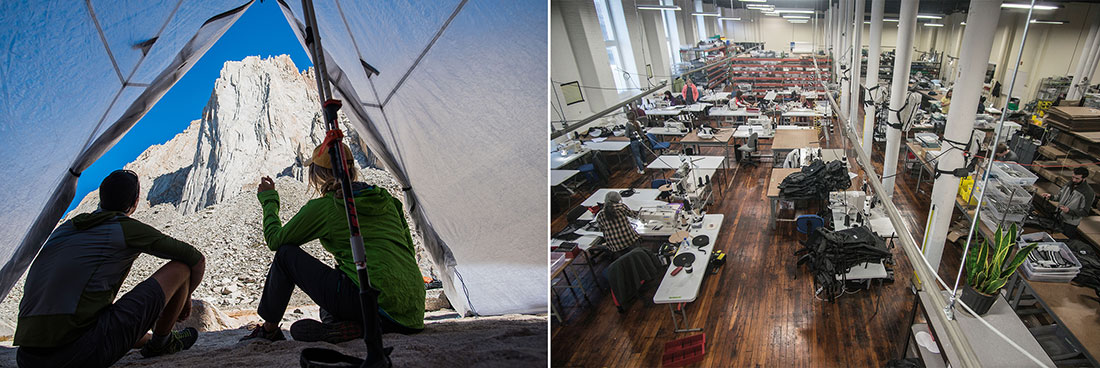
Under high ceilings, with workstations and sewing machines set on worn wood floors, the staff of Hyperlite Mountain Gear builds some of the market’s lightest and most-durable outdoors gear.
The materials lean space-age and expensive, including Cuben Fiber fabric, Spectra cord, mesh, and the tapes and agents required to make a line of boutique backpacks, shelters, tarps, and accessories used by hikers, climbers, and explorers around the globe.

This month, at a ceremony in Utah, Hyperlite Mountain Gear was recognized for its made-in-America story. Founded in 2010 by Mike St. Pierre, a former New York chef turned designer and gear-head, and his brother, Dan St. Pierre, Hyperlite Mountain Gear now employs 24 people and makes all its goods in Maine.
The company won the fourth-annual American Made Outdoor Gear Award. The recognition, conceptualized and hosted by Kokatat Inc., has gained buzz in the outdoor industry for its refocusing on domestic production and gear design among a glut of products made overseas.
Hyperlite Mountain Gear is a callout success story, doubling in size every year since its inception and creating lauded products. It was cited in the award ceremony as driving domestic manufacturing, innovation and growth, as well as a commitment to a local community in Maine.
Past overall American Made Outdoor Gear Award winners are Liberty Bottleworks, Benchmade Knives, andSterling Rope. This year, other U.S.-based brands, including Farm to Feet, Timbuk2,DPS Skis, and Duckworth, were category winners at the event.
We caught up with Hyperlite Mountain Gear to get details about its operations and its plans for expansion. Lizzy Scully, marketing director, shared the company’s award application for background on the company’s commitment to made-in-USA.
Why is domestic production important to your company?
Originally, as a young start-up, we didn’t really see any other way of doing it. But as we grew, we realized there were many benefits to producing domestically. First, our products are made using [some of the] most advanced materials technology available to the outdoor industry, Dyneema and Cuben Fiber. These materials are much different than any other traditional woven fabric used in our industry. We had to develop unique production, sewing and bonding techniques in order to make ultralight gear that could withstand the harshest demands of our customers. Our fabrics are 100% waterproof, meaning we had to develop unique methods, by hand, for “re-sealing” stitch holes that occur during production. We also primarily work with laminate fabrics, meaning precision stitching is much more critical than when working with woven fabrics.
All of this process development and training took tinkering, time and ingenuity before finding the right production recipes to create high quality gear. There is just no way we could have sent off designs and raw materials to Asia and have ended up with a product that worked. In-house manufacturing gives us much more control over our quality, which is critical.
Does producing domestically make your company more nimble?
We are in a new era where customers provide feedback quickly, and to maintain a strong business you must listen to your customers as some of them have really great ideas. If we see a problem with a product, or receive an incredible suggestion from a customer that we just haven’t thought of, we can very swiftly make in-line improvements or changes. If we were outsourcing our production, we’d be placing much larger production run orders and would be much slower to incorporate innovation. In this day and age, we feel it is very important to be nimble.

We also have one of the most competitive lead times in the outdoor industry. Many of our competitors are sourcing materials and manufacturing overseas, and they experience long lead times when they deplete supply of outsource manufactured product, or they have a six to twelve week lead time when building to order. We ship most products immediately upon order, in just a week when stock needs to be replenished, and we can also build to order in less than two weeks for customizations.
Are there financial advantages to a domestic production model?
We eliminate third-party manufacturing mark-ups, which would be significant due to the high cost of our advanced material technology and the increased production time it takes to work with these high-tech materials. It seems counter-intuitive, but in our case, domestic manufacturing actually helps keep the costs down for the consumer. We are also able to operate “just-in-time,” which means we can somewhat predict our short-term growth and manage both raw material and finished goods inventory. The positive cash flow effect, compared to holding large inventories from an outsourced manufacturer, is very important to us.
You are a significant employer in a midsize town. How does that affect your view of business?
We are proud to be manufacturing here in Maine and to be providing manufacturing jobs in an old mill town that nearly died following America’s manufacturing exodus to Asia decades ago. And we are proud of our employees who are dedicated craftspeople ensuring that the products we sell all around the world, and that are used in some of the harshest environments on the planet, work well and hold up for our customers. This is all very important to us and our brand.
Has domestic manufacturing helped Hyperlite Mountain Gear gain market share in your category?
We certainly think so. While our biggest gains in market share come from our innovative product designs and innovative materials technology we don’t think it would be possible without domestic manufacturing. Additionally, our market share increases as more and more people recognize the benefits of American-made products. American manufacturers make high quality products that last. They contribute to economic growth and consumers can have a direct connection to the products they consume.
What is the biggest challenge of producing domestically?
Many outdoor gear companies outsource their manufacturing, meaning they don’t have to deal with hiring, training, procurement or the management of production staff, thereby allowing them to focus solely on R&D, marketing and sales. But domestic manufacturing, compared to overseas manufacturing, has its own set of unique challenges. They are, primarily, the financial costs associated with the higher labor costs of a U.S. labor pool compared to the low costs of Asian labor. In any industry, not only ours, where similar products are being made both domestically and overseas, it almost always means the domestic versions will be more expensive to the consumer. We’re okay with this as we have a premium brand offering premium products and the trade-off, in our opinion, is a higher quality product.

A second challenge with domestic manufacturing is finding skilled labor from a pool that has lost much of its manufacturing experience over the past 20 to 30 years. There’s a skilled labor experience gap of an entire generation and finding high-value, quick learning, dedicated production employees and craftspeople will always be a challenge until more and more insourcing occurs. And when we find these high-value employees, it most often means they must be trained, which again has associated costs and time.
What are the challenges and barriers to using domestic materials?
The main challenge or barrier to using domestic materials is very similar to the main challenges of a domestic labor force; they are more expensive. Domestic materials are produced using a local labor force at higher wages compared Asian overseas labor and are understandably higher priced. But once again we consider there to be a trade-off in price versus quality. American-made goods have traditionally been associated around the world with high quality and we don’t view it any differently now despite the past several decade trend of outsourcing American manufacturing to Asia.

We believe in the quality of our American-made products and the benefits we provide to our local economy by producing here. We also believe that after 20-30 years of declining American manufacturing and increasing consumerism of disposable products, Americans are remembering, and the younger generations are learning, the importance of high-quality products that perform and last, which is why, we think, there is a new growing trend toward American insourcing. At the end of the day, the main challenge is competing with lower priced, internationally produced goods. But again, consumers seem to be starting to remember that you get what you pay for.
What is the furthest distance you source a domestic material?
Being located in Maine means many of our suppliers are far away. But those furthest away include our primary raw material supplier located in Arizona and a small raw material supplier in California. But we are also fortunate to have some suppliers right here in Maine and in the neighboring state of New Hampshire. Maine has a respectable rope industry due to its rich fishing and boating industries, and we do source our rope and line needs locally whenever applicable.
How does domestic manufacturing support your business outside the U.S.?
A growing number of countries are aware of the high quality of American-made products, both in the past and now that there is a growing resurgence in American manufacturing. We are raising the bar for product quality compared to our offshore competitors, and consumers in Asia and Europe recognize this. We do see this reflected both in a growing interest in our products and in increasing shipments to these areas. We expect continual growth in the Europe, Australia, New Zealand, Japan and South Korea.
What advice would you give to a company thinking about producing their product domestically?
Build a stable of domestic suppliers to maximize your agility in serving whatever market you enter. Then make only the highest quality products that last in order to differentiate yourself from the competition and thus maintain the reputation of the American-made label. We would also advise that there is a lot of opportunity in domestic manufacturing, however, given the manufacturing skill gap that was created in the last three decades, be prepared for the challenges of finding a strong workforce. Know your own product, and how it is produced, because you will likely have to train your staff.
–See the Hyperlite Mountain Gear product line and learn about the company at hyperlitemountaingear.com.
Circulation: 101,340
LINK


